
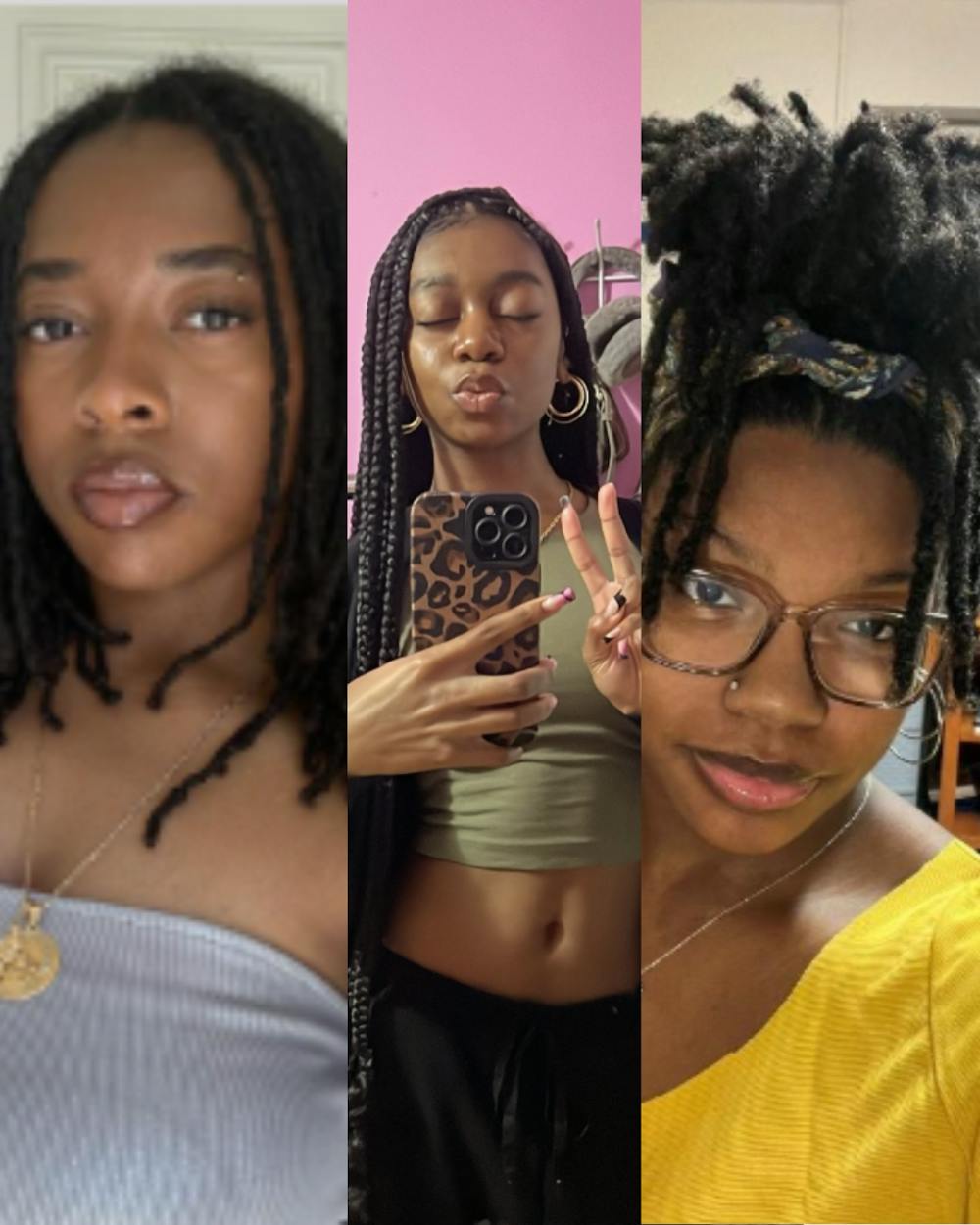
At Seton Hall, hair is far more than something students simply style before class. It’s a powerful expression of identity, culture, and personal transformation.
Across campus, students describe their hair as a source of confidence, a reflection of heritage, and a reminder of their growth. And for others, it is an evolving relationship filled with experimentation, pride, and self-discovery.
For Maryann Burt, a freshman psychology major, that relationship is complicated. Some days she loves her long, wavy brown hair and on others, she wants to “dye it or get it cut.” She prefers simple, layered styles and said mousse and a loose, natural look are her favorites.
Though she has never dyed her hair, she has tried shorter cuts and curtain bangs, but she feels most like herself with “long hair with layers.”
If Burt’s hair could speak for her, she said, “it would say that [she is] a more shy and reserved person,” explaining that she often hides behind it, finding comfort in its length.
Addison Oakley, a freshman political science major, experiences her hair as both self-expression and cultural connection. As a Black student on a predominantly non-Black campus, she explains that bold or creative hairstyles can come with mixed feelings.
“SHU can be welcoming, but being surrounded by people who don’t look like you and who sometimes stare at anything they see as ‘different’ can make it harder to feel completely comfortable,” Oakley said.
Yet, she emphasizes the importance of expressing individuality despite the pressure.
Oakley also stated that expectations of “professionalism” often push Black women to alter their natural hair to fit social norms. Her own Jamaican and Guyanese heritage plays a major role in her styling choices, especially her love for knotless braids, a style that grounds her in her cultural tradition. Despite the challenges, she says the reaction on campus has been “really positive.”
For Kahlilia Watson, a sophomore interprofessional health sciences major, hair is a source of joy, pride and personality. She describes her hair as thick and bold, and sometimes difficult to manage, yet she loves it deeply.
“I love my hair, and I have to keep it styled because it’s so thick and hard to manage at times,” Watson said.
Despite the pressures that some students feel on campus, Watson explains that SHU hasn’t changed how she views her natural hair.
“Being a Seton Hall student hasn’t affected my views on my hair, and I love it just the same,” Watson said.
Christian Quiñones, a freshman history major, views hair as “central to self-identity. He calls his connection to his hair “somewhat sacred,” emphasizing that it represents who he is and how far he has come.
His current middle-part style symbolizes emerging confidence after past struggles with self-image and weight. Changing his hairstyle marked a turning point for him as it allowed him to “express individuality, without conforming to expectations.” Though Quiñones occasionally hears the “you need a haircut” from his family, he emphasizes that his hair is his own expression.
“It’s my hair on my head; who cares what they think,” Quiñones said.
For Jasmine Nelson, a freshman law and diplomacy major, her hair is very special. Nelson wears locs, which she describes as symbols of cultural pride, resistance against oppressive beauty standards and a reminder of her African ancestry.
Inspired by her mother and her siblings, who began their own loc journeys before her, Nelson now experiments daily, transforming her hair into buns, scarf styles and new combinations that reflect her mood and identity.
“Wearing my locs makes me feel like I can be 100% myself,” Nelson said.
Rhyanna Robinson, a freshman biology major, has been on a four-year journey with her locs, describing it as a “trust the process” experience that taught her loyalty to herself and her hair.
Currently wearing knotless braids, Robinson says the style brings her back to earlier years before her loc journey began. She has tried countless styles, but her all-time favorite remains her two-strand twist: a clean, classic and always reliable style that “is chef’s kiss.”
As a Black woman, Robinson’s hair embodies cultural identity, resilience and advocacy. She takes pride in the growing loc community at SHU.
“I...think SHU is a welcoming environment for students to be creative with their hair,” Robinson said. “I have seen a multitude of bold hairstyles and colors that look amazing...there are a decent amount of people in the loc community on campus, which I love to see,”
Beyond individual expression, SHU also builds community through the Having Appreciation in Realness (H.A.I.R.) club, which supports students in learning about and embracing their natural hair.
The club’s co-event coordinator, Jessica Estime, a senior criminal justice and psychology major, sees firsthand the impact the group has on campus. Students come to events to learn not only techniques and hair care tips but also deeper perspectives on the Black hair community.
“[An event] has to be fun, but it also has to make some type of impact on people when they walk out that door,” Estime said.
Estime explained that the club has grown significantly, especially within the executive board, whose collaboration has strengthened planning and event quality.
They partner frequently with other campus groups, including a recent event with the Alpha Kappa Alphas (AKA), where students made their own hair masks and oils using natural ingredients like eggs, avocados, and bananas.
For Estime, the ultimate goal is empowerment. After years of feeling insecure about her own natural hair, she hopes her work in the club encourages others to embrace theirs. Locking her hair helped her finally feel comfortable, and she wants all students to see their hair differently and recognize its beauty.
Across campus, students’ stories reveal that hair is far more than appearance. It is culture, memory, confidence, and resistance. Hair is not just what keeps our head company; it’s part of our identity and tells a story through every strand.
Kassandrah Blake is a writer for The Setonian’s Features section. She can be reached at kassandrah.blake@student.shu.edu.


